Each day consumers are motivated to do, be and have better. We want the latest cars, clothes and houses. We want to look, feel and live better than ever before or anyone.
I am certain that we are all motivated to live as fancy and luxurious as this

According to various theories and theorists, motivation is rooted in the basic need to minimize physical pain and maximize pleasure (Jerome. N, 2013), or it may comprise of definitive needs such as eating and resting, or a desired object, hobby or goal (Durmaza. Y, 2011).
Consumer behavior studies how each consumer, group or organisation select, purchase and utilise goods and services to simultaneously satisfy their needs and desires. A consumers behaviour is continuously changeable however, there will always be a deeper form of motivation that drags a consumers attentions towards the product (Aruma. E. O, Hanachor. M, 2017). Garnier is a self-care brand that aims to assist consumers with their every-day hygiene, this plays as a physiological need as it is a necessity. Whether a consumer
So when we associate Garnier with that of motivation, what influences one to purchase Garnier contrasting that of other products and brands. What makes me want to buy Garnier over a Coles brand shampoo.
Garnier presents itself within the approach-approach conflict- this is where a consumer is conflicted between two appealing choices
E.g. Garnier shampoo vs. Coles brand shampoo
However, the moving notion that influences a consumer to purchase one of the objects is the characteristics of one of the options.
This is Garnier:



Garnier value what they place in their products, ensuring that only natural and organic ingredients are put into Garnier (Carroll, A.B, 1991). Any product that we place on our skin or hair is eventually absorbed into our body, this is where we must take a stand and educate ourselves on products that may be harmful to the human body. Consumers who are invested in what they put on their body will be further motivated to purchase Garnier as they only have natural and organic ingredients.

Furthermore, Garnier heavily invests themselves in charity and eco-friendly measures. They have partnered with charities such as Unicef and Terracycle to try and make the world cleaner, better and safer for future generations.
So what motivates us to purchase Garnier?
Perhaps because they believe and stand by something that most other organisations do not. They invest their money and time into not only improving their products and ensuring that only the finest ingredients are put forward, but to also ensure that we live in a happier and safer society.
Maslows Hierarchy of Needs:
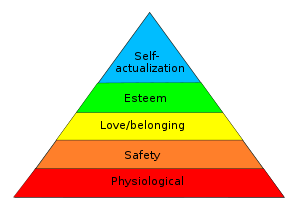
Maslow’s hierarchy of needs is a theory in psychology proposed by Abraham Maslow in his “A Theory of Human Motivation”( Jerome. N, 2013). He included a classification system which reflected the universal needs of society as its base and then proceeding to more acquired emotions. Maslow’s hierarchy of needs is used to study how humans intrinsically partake in behavioral motivation. Maslow used the terms “physiological”, “safety”, “belonging and love”, “social needs” or “esteem”, and “self-actualization” to describe the pattern through which human motivations generally move (Jerome. N, 2013). This means that in order for motivation to occur at the next level, each level must be satisfied within the individual themselves. Furthermore, this theory is a key foundation in understanding how drive and motivation are correlated when discussing human behavior.
REFRENCES:
Aruma. E. O, Hanachor. M, (2017), Abraham Maslow’s Hierarchy of Needs and Assessment of Needs in Community Development, International Journal of Development and Economic Sustainability, Vol.5, No.7
Retrieved on: 14th May 2019, Accessed on: http://www.eajournals.org/wp-content/uploads/Abraham-Maslow’s-Hierarchy-of-Needs-and-Assessment-of-Needs-in-Community-Development.pdf
Jerome. N, (2013), ‘Application of the Maslow’s hierarchy of need theory; impacts and implications on organizational culture, human resource and employee’s performance’, International Journal of Business and Management Invention, Volume 2 issue 3
Retrieved on: 17th May 2019, Accessed on: https://pdfs.semanticscholar.org/b0bc/c8ca45193eaf700350a8ac2ddfc09a093be8.pdf
Y. Durmazα, I. Diyarbakırlıoğlu, (2011), ‘A Theoritical Approach to the Strength of Motivation in Customer Behavior’, Global Journal of Human Social Science, Volume 11 issue 10 Version 1.0
Retrieved on: 17th May 2019, Accessed on: https://globaljournals.org/GJHSS_Volume11/7-A-Theoritical-Approach-to-the-Strength-of-Motivation.pdf
Carroll, A.B, (1991), ‘The Pyramid of Corporate Social Responsibility: Towards the Moral Management of Organizational Stakeholders’ Business Horizons.
Retrieved on: 23rd May 2019, Accessed on: http://www.csrquest.net/default.aspx?articleID=12770&heading=.
Garnier, (2019), About
Retrieved on: 14th May 2019, Accessed on: https://www.garnier.co.uk/withingarnier/about-garnier
 BELLA'S BLOG