
“In consumer life we become what we consume-disposable junk to be used and thrown away.”
― Bryant McGill, Voice of Reason
Consumer Behaviour is the study and investigation into the conceptualisation of how individuals make decisions when having the desire or need to purchase a product or service. It is vital to acknowledge the influence of consumer behaviour and the role it plays in assistance to consumers responding to new products and services.
What Dark Side?
Unfortunately, we live within a society that at times may be precarious and push cultural values and perspectives on others, leading to social pressures and negative consequences. Such social pressures include excessive drinking, smoking and drug taking which, clout future complications.
Deviant Consumer Behaviour
Deviant consumer behaviour refers to ‘actions that violate the accepted behaviour in a consumer context and result in harm for the consumer’. When a certain behaviour becomes classified as a ‘norm’ or accepted into mainstream society, it is no longer considered deviant.
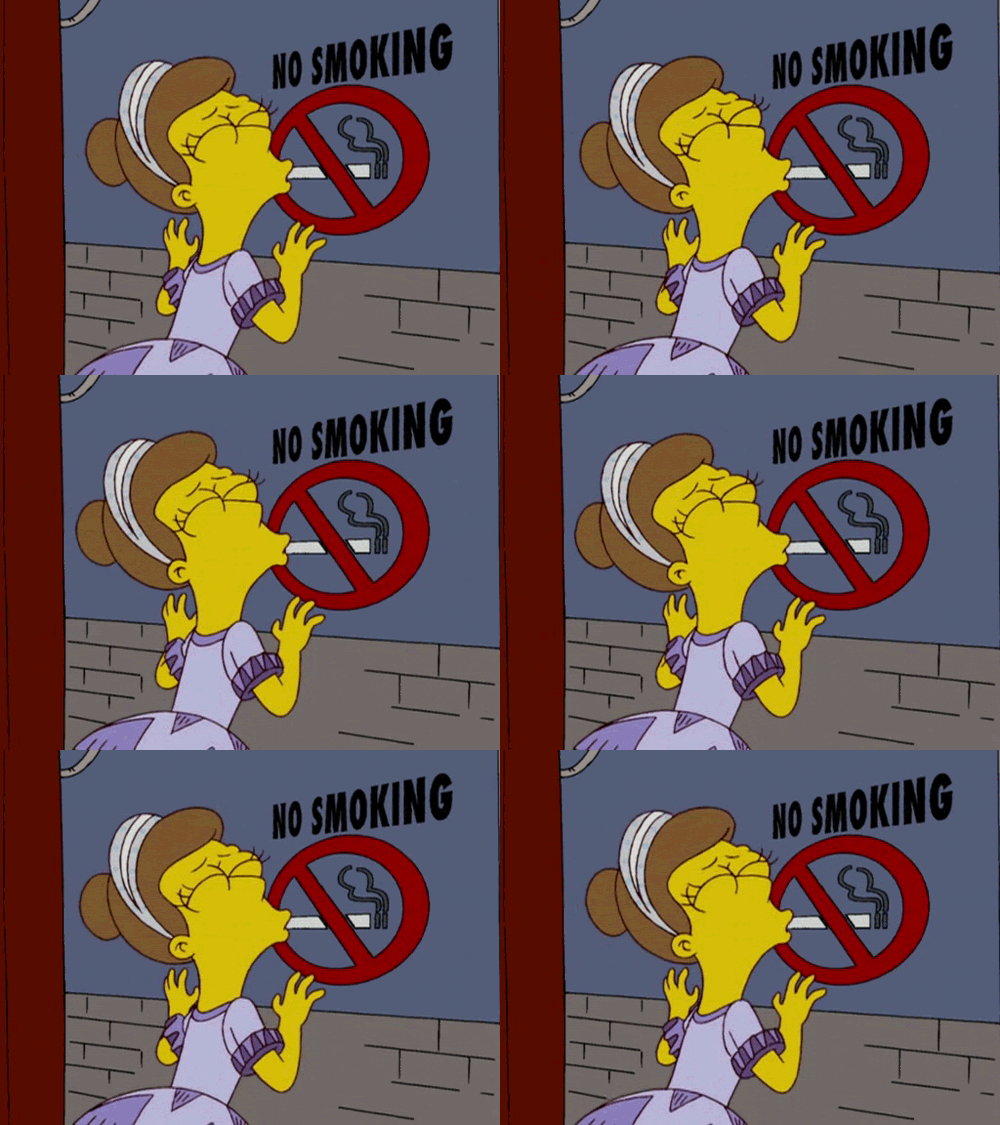
EXAMPLE: Prior 1995, smoking indoors in public venues such as restaurants, pubs, or sporting events was recognised as legal. Previous to this legal change, it was recognised as a normality to smoke a cigarette indoors in any public venue even if surrounded by small children or ill individuals. Consequently, due to the spike of lung cancer and other deadly diseases instigated by smoking, the Australian Federal Government redrew and have since made smoking indoor public areas illegal. The Australian Government now recognise the health risks and declared this act be illegal within all states and territories of Australia. Smoking indoor public venues was once a normality within Australian society however, today it is both illegal and frowned upon thus, anybody partaking in this act is identified as partaking in deviant behaviour.
Consumer Terrorism
Terrorism is one of the most despicable and abhorrent acts that has ruined the lives of so many innocent civilians. Terrorism is identified as acts of violence and intimidation -usually against civilians, in order to reclaim political correctness. One of the most disturbing terrorism acts in the world is that of 9/11, where terrorists crashed multiple planes into New York City’s financial buildings, ‘The Twin Towers’.

Two of the biggest forms of terrorism:
- BIOTERRORISM: A strategy to disrupt a nations food supply with the sole purpose of creating an economic havoc.
- CYBERTERRORISM: Utilisation of computers or other forms of information technology networks with the prime intention of creating a mass destruction, damage or harm.
ADDICTIVE CONSUMPTION
Addictive consumption is one of the world most challenging problems, leading to sole reliance on products and services that impact the wellbeing of individuals. A woman in Texas, USA was found dead in her home in 2013 …
The reason? Addiction to Coca-Cola.
She had become so reliant on the drink, she had consumed approximately eight bottles of 1.5 litres per day for three years. Such addictive consumption can lead to dangerous and life threatening habits. Other forms of addictive consumption include the acts of hoarding, shopping or the consistent desire and necessity to always be ‘in-style’.
As children begin to attend school, they compare themselves to other children in their classes in terms of the newest toys, games, books, electronics or clothes. They consistently ponder on what they “have” and “don’t have.”. Consequently, this behaviour revolves in a perpetuating cycle as generations continue with new products and services consistently being brought out. The problem only worsens as we age and begin comparing heavier financial objects such as homes, cars, weddings or careers.
CONSUMED CONSUMERS
Consumed Consumers is a bleak and disheartening concept of the dark side of consumer behaviour. It involves individuals being exploited and abused both with or without consent for commercial gain in the marketplace. An aspect of consumed consumers is that very little, the exploited person/s is left unpaid and vulnerable by a guilty third party. For example, prostitues and escorts are threatened and blackmailed while their ‘pimps’ live successful and luxurious lives off their dirty money.
EXAMPLES:
- Human trafficking: Many individuals involved in human trafficking are unwilling and have been taken against their will or threatened that if they escape or tell others, they, or their family will be killed.
- Organ Donation: Often when a loved when passes, they have written in their will what to do with their remains (buried, cremated, donated for science/others). Occasionally, this is done illegally and without the family of the loved one’s consent. Some doctors illegally take organs or other parts of the party dedicating it to further research in science or medical needs, or for individuals who are suffering and need certain organs for survival. Further some organs may be sold on the dark web for personal gain such as financial.

 BELLA'S BLOG